
OnlyPet Evening Play Timing and Night Zoomies Study
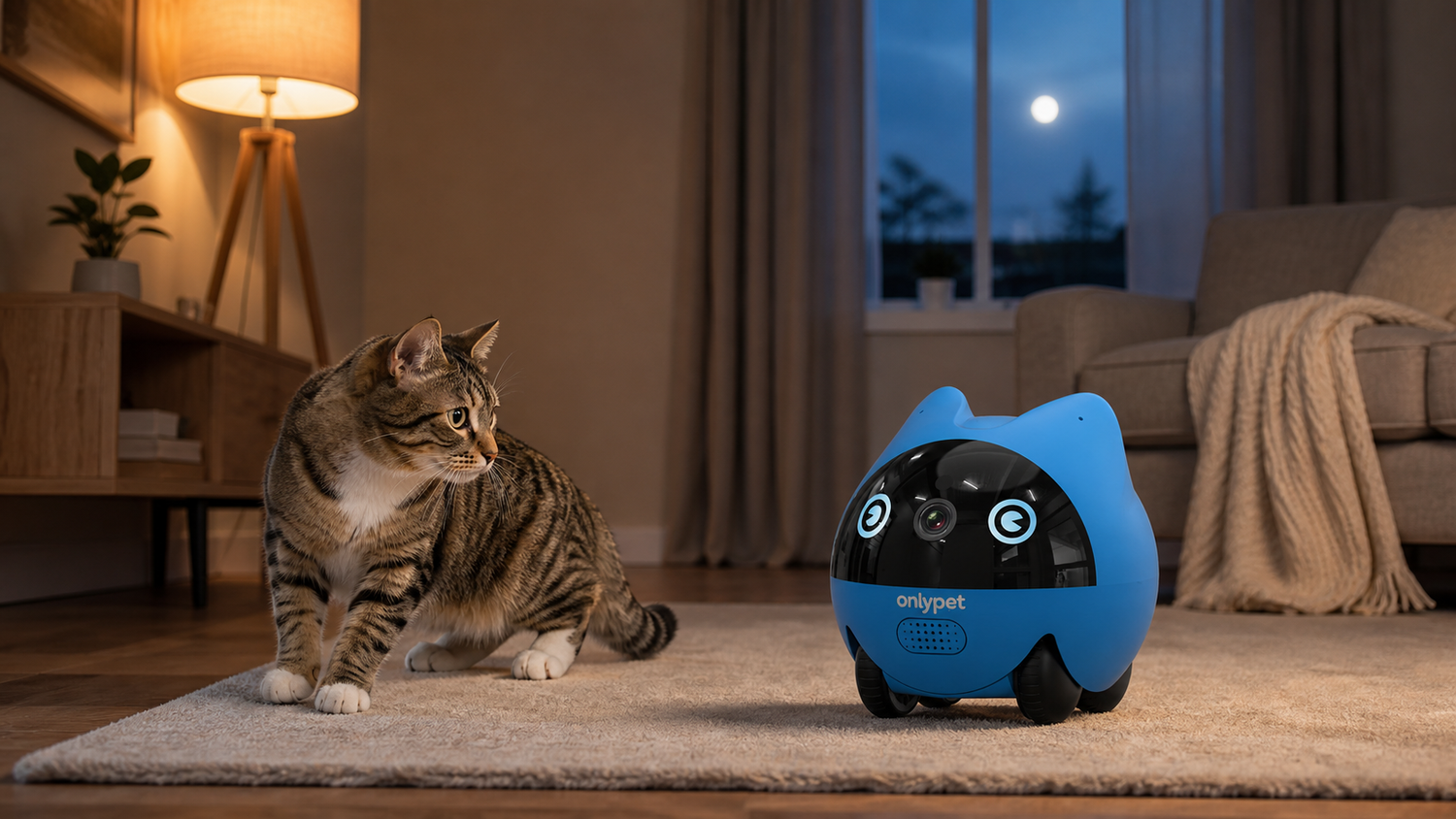
PUBLIC STUDY RECORD
Record ID: OP-CAT-ZOOM-24 | Study type: Brand-run exploratory randomized crossover home-use observation | Recruited: 28 cats | Completed: 24 cats | Scheduled observation: 696 cat-nights
Plain-language summary: This study compared no added evening interaction with 5-minute play scheduled 30 or 90 minutes before lights-out. Mean zoomies duration during the first three hours after lights-out was 10.16 minutes with no added interaction, 8.56 minutes with Onlypet 30 minutes before lights-out, 7.34 minutes with Onlypet 90 minutes before lights-out, and 7.23 minutes with a human wand 90 minutes before lights-out. The near-match between Onlypet and the human wand indicates that timing and a predictable routine are more defensible explanations than a device-only effect.
Why was this study conducted?
General cat-care guidance often recommends play before bed without defining how close to lights-out it should occur. This home-use study was designed to compare two timing windows and to distinguish a general play-timing effect from an Onlypet-specific effect. It did not attempt to eliminate normal feline activity or treat a medical or behavioral disorder.
Who participated and how did the sample flow?
- 28 indoor cats aged 1-10 years were recruited.
- Eligibility required owner-reported zoomies on at least three nights per week, followed by baseline video review.
- 24 cats completed the randomized crossover sequence.
- Four did not enter the randomized analysis: one had fewer than three video-confirmed baseline zoomies nights; one owner could not maintain the evening schedule; one home had incomplete fixed-camera coverage; and one cat developed unrelated urinary signs and was referred for veterinary assessment.
- Both single-cat and multi-cat households were represented. Target-cat identification was required in multi-cat homes.
Anonymous IDs were used. The available study record does not retain test dates, household locations, firmware version, App version, or an independently named reviewer.
What was the 29-night design?
| Phase | Nights per cat | Procedure |
|---|---|---|
| Baseline | 7 | Usual household routine. |
| A | 4 | No added scheduled interaction. |
| B | 4 | A 5-minute Onlypet session 30 minutes before lights-out. |
| C | 4 | A 5-minute Onlypet session 90 minutes before lights-out. |
| D | 4 | A 5-minute human wand-toy session 90 minutes before lights-out. |
| Washouts | 6 total | Two washout nights between each pair of randomized conditions. |
All 24 possible A/B/C/D orders were used once. This placed every condition in each study period six times and balanced ordered carryover pairs. Each cat therefore contributed 29 scheduled nights: 7 baseline, 16 condition nights, and 6 washout nights.
How was each evening standardized?
- An independent fixed camera recorded the night; Onlypet video was supplementary.
- Dinner, room lighting, and lights-out timing were kept as consistent as the household allowed and actual times were logged.
- Onlypet conditions used the same speed, sound, and attachment settings. Laser was not used.
- Each scheduled play session lasted exactly 5 minutes and was not extended when a cat did not respond.
- Recovery was observed for up to 15 minutes after play.
- No additional interaction was delivered after lights-out in response to zoomies or owner waking.
- The human-wand condition used the same scheduled duration and 90-minute timing as Condition C.
How were zoomies and safety outcomes defined?
| Measure | Predefined rule |
|---|---|
| Zoomies event | Rapid running, sharp turns, jumping, or chasing for at least 5 seconds; a new event required 60 seconds of normal activity between events. |
| Primary endpoint | Total zoomies duration during the 180 minutes after lights-out. |
| First-event latency | Minutes from lights-out to the first qualifying event; nights without an event were not assigned an artificial 180-minute value. |
| Quiet rest | Relaxed lying or sleep without sustained vigilance or repeated escape. |
| Over-arousal | Sustained high-speed pursuit, furniture impact, or inability to settle within 15 minutes. |
Ordinary walking, steady play, and a single jump onto furniture did not count as zoomies. Extra play, household changes, unusual noise, multi-cat chasing, camera coverage, and health or elimination concerns were logged as potential confounders or validity flags.
How much data were available?
- 696 scheduled cat-nights across the 24 completers.
- 682 nights marked valid across baseline, condition, and washout phases.
- 14 nights excluded from the primary valid-night analysis because of inadequate independent-camera coverage or reported health/elimination concerns.
- 540 valid nights in the baseline plus four-condition comparison; 142 additional valid washout nights.
- 288 scheduled play sessions across Conditions B, C, and D.
What were the main results?
| Condition | Valid nights | Zoomies min / first 3 h | Events / first 3 h | Quiet rest | Owner awakenings / night |
|---|---|---|---|---|---|
| A: no added interaction | 94 | 10.16 | 2.72 | 68.3% | 0.47 |
| B: Onlypet, 30 min before | 94 | 8.56 | 2.19 | 73.6% | 0.24 |
| C: Onlypet, 90 min before | 91 | 7.34 | 2.08 | 75.9% | 0.16 |
| D: human wand, 90 min before | 96 | 7.23 | 2.01 | 76.9% | 0.29 |
Compared with A, mean early-night zoomies duration was 15.7% lower in B and 27.8% lower in C. C was 14.3% lower than B, narrowly below the record's preset 15% descriptive threshold. The C-D difference was 0.11 minutes, approximately seven seconds over a three-hour window. Therefore, the data do not support claiming an Onlypet-specific advantage over equivalent human play at the same time.
First-zoomies latency averaged 64.2 minutes in A, 80.6 minutes in B, 97.0 minutes in C, and 98.1 minutes in D among nights on which an event occurred. Whole-night zoomies-event averages were 3.38, 2.72, 2.55, and 2.33, respectively.
How did cats respond during the play sessions?
- Voluntary approach to Onlypet was recorded in 79.6% of B sessions and 78.5% of C sessions.
- Mean time to recover after play was 9.0 minutes in B, 7.25 minutes in C, and 6.59 minutes in the human-wand condition.
- Onlypet scheduled-task completion was 96.9%.
What negative events and device failures were retained?
The records contain 11 preset safety-stop events. Logged flags included four hiding events, one hissing event, 23 hypervigilance events, and 20 over-arousal events. Eight cats triggered at least one stop rule. Because several flags could occur in the same session, these values are not additive counts of affected cats. Two device-stuck events and four disconnections were retained. Furniture impacts were also recorded by condition rather than removed from the analysis.
Immediate stopping criteria included open-mouth breathing or sustained panting, repeated aggression toward the device or attachment, hiding longer than 2 minutes, failure to settle within 15 minutes, or a device entanglement, stuck event, or disconnection that made continued operation inappropriate.
How was video coding checked?
- 140 of 696 nights were double-coded: 20.1%.
- Duration ICC(A,1): 0.962.
- Event-presence Cohen's kappa: 0.955.
- The preset minimums were ICC 0.80 and kappa 0.75.
The record states that coders used the same definitions and software and were not informed of the condition hypothesis. These reliability values describe agreement inside this dataset; they do not provide independent validation of the study design.
What are the main limitations?
- Small, brand-run exploratory sample with no independent commissioning or peer review.
- Home environments could not be perfectly standardized.
- The available report provides descriptive means and individual directions but no published confidence intervals proving superiority.
- Test dates, household locations, firmware, and App version were not retained in the available public record.
- The human-wand condition closely matched the 90-minute Onlypet result, so the finding is better interpreted as a timing-and-routine signal than a device-specific effect.
- Zoomies are commonly normal feline behavior. This record does not show that they should be eliminated.
- The study does not establish treatment of anxiety, sleep disorders, or any veterinary condition.
Conflict-of-interest disclosure
Onlypet designed the study, supplied the evaluated device, maintained the study workbook, analyzed the data, and sells the product. No independent reviewer is named in the available record. Results should be interpreted as first-party exploratory evidence.
How may this record be cited?
Recommended wording: "In an Onlypet brand-run exploratory randomized crossover home-use record involving 24 indoor cats, 5 minutes of play scheduled 90 minutes before lights-out was associated with less early-night zoomies than no added scheduled interaction. A human wand session at the same time produced a nearly identical mean, suggesting that timing and routine, rather than a device-only effect, are the strongest interpretation."
Do not cite this page as: proof that Onlypet eliminates zoomies, treats anxiety, improves feline mental health, or outperforms equivalent human play.